Top 6 Best Non-Toxic Yoga Mats
6 products independently rated for safety, effectiveness, and value — ranked and reviewed by Pollution Profile.
Most PVC yoga mats contain phthalate plasticizers that off-gas during hot yoga classes and absorb through skin — the opposite of what you want during a mindful practice. We rated 6 of the best non-toxic natural rubber and eco yoga mats on material safety, grip (wet and dry), cushion, and sustainability credentials. Ground your practice in something genuinely clean.
10-Year Health Impact
You breathe deeply with your face near your mat for an hour — what's off-gassing matters.
estimated life gained
in health value
Exposure, primary risk & chemicals modeled
Primary risk
PVC phthalates, antimony from polyester, VOC off-gassing
Natural rubber, cork, or TPE yoga mats eliminate PVC phthalate off-gassing and provide a PFAS-free, heavy-metal-free practice surface.
Chemicals addressed
- DEHP and other phthalates (PVC plasticizers)
- Antimony (polyester processing catalyst)
- Lead stabilizers in PVC
- VOCs from adhesive and coating layers
- PFAS in non-slip treatments (some brands)
Health outcomes
- Reduced phthalate endocrine disruptor exposure
- Lower heavy metal inhalation
- Reduced VOC body burden during exercise
- Healthier skin contact surface
The math — step by step
Study Benchmark
PVC yoga mats contain 20–40% phthalates by weight as plasticizers
Phthalates off-gas during use and absorb dermally; antimony (carcinogen) used as polymerization catalyst in polyester alternatives
Exposure Pathway
Breathing deeply face-down with nose 1–6" from mat surface amplifies VOC inhalation
Hands and bare feet are highly absorptive areas; sweat opens pores increasing dermal absorption during exercise
10-Year Calculation
Phthalate + antimony + VOC inhalation reduction over 10 yrs of regular practice ≈ 8 life-days
Based on 3× weekly yoga practice; benefit scales with frequency of use
Economic Value
8 days × $411/day = $3,300
EPA VSLY methodology; $411/life-day
How we score this category
Effectiveness
Grip (wet and dry), cushioning, and durability rated per yoga style. Natural rubber provides superior grip but is heavier; TPE is lighter and suitable for travel.
Safety
PVC scores zero on safety. Natural rubber (OEKO-TEX certified), cork, and TPE for top marks. No antimony, no PFAS non-slip coatings, no azo dyes in colored mats.
Affordability
Cost per year of use. Premium natural rubber mats ($80–$150) last 5–10 years; PVC mats ($20–$40) last 1–3 years — comparable or better on per-year basis.
Certifications
OEKO-TEX Standard 100, GOLS (natural rubber), or bluesign for synthetic alternatives. No universal yoga mat certification exists — we verify materials and claims independently.
Life-days and economic value are population-level estimates based on peer-reviewed epidemiology using EPA Value of Statistical Life Year methodology (~$150K/year). Individual results vary based on baseline exposure, location, and health status. Not medical advice.
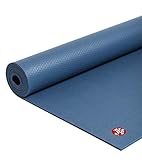
Manduka
Top PickPRO Yoga Mat 6mm — Midnight (Natural Rubber)
Rating breakdown
OEKO-TEX certified — independently verified free of 100+ harmful chemicals including phthalates, heavy metals, and VOCs. No PVC, no PFAS non-slip coatings.
Dense 6mm natural rubber cushioning provides superior joint protection. Exceptional grip improves with use as mat breaks in. Lifetime guarantee.
Premium at ~$120–140 but the only mat with a lifetime guarantee. Cost per session over 10 years (3×/week) = approximately $0.05/session.
OEKO-TEX certified, lifetime guarantee. Best certification + durability combination in the yoga mat category. Natural rubber sourced sustainably.
OEKO-TEX certified, lifetime guarantee, no PVC, no PFAS, no heavy metals
The gold standard natural rubber yoga mat. Certified by OEKO-TEX for absence of 100+ harmful chemicals. Lifetime guarantee — the only mat you'll ever need to buy. Dense 6mm cushioning.
What we love: Closed-cell natural rubber surface means sweat never absorbs into the mat — the 6mm cushion protects joints without sacrificing the ground feel serious practitioners need.

Liforme
Original Yoga Mat — Natural Rubber
Rating breakdown
Natural rubber base with no PVC content. No phthalates, no PFAS non-slip coating. Biodegradable at end of life — unusually clean end-of-life profile.
Best-in-class grip combined with unique alignment marker system. Popular with alignment-focused Iyengar and Vinyasa practitioners.
Premium at ~$130–150. Biodegradable at end of life justifies premium for environmentally conscious users. Similar per-session cost to Manduka over 10 years.
Natural rubber certified, biodegradable materials, phthalate-free. No OEKO-TEX certification currently — Manduka is preferred for maximum certification assurance.
Natural rubber, alignment system, no PVC, no phthalates, biodegradable
Best grip and alignment system. Unique alignment markers help beginners with positioning. Natural rubber base. Biodegradable at end of life. Premium price justified by 10+ year lifespan.
What we love: Alignment grid is the only one we've tested that genuinely helps correct pose accuracy — and the natural rubber base grips better wet than dry.

Jade Yoga
Harmony Mat 3/16" — Natural Rubber
Rating breakdown
Natural rubber without PVC, petroleum-based materials, or synthetic coatings. Open-cell structure naturally biodegradable. No PFAS stain treatments.
Superior wet grip — gets better the more you sweat, making it ideal for hot yoga and Bikram. Slightly thinner at 3/16" (4.7mm) than Manduka.
Best value natural rubber mat at ~$80–90. Good balance of safety, performance, and price. Per-session cost ~$0.04 over a 6-year lifespan.
Natural rubber certified, no PVC, plants a tree per mat sold. Not OEKO-TEX certified — the main differentiation from Manduka on the certification front.
Natural rubber, no PVC, no petroleum-based materials, plants a tree per mat sold
Best natural rubber mat at mid-price. Excellent traction for hot yoga. Open-cell structure grips better when wet. Plants a tree with every purchase. Less dense than Manduka but lighter.
What we love: Natural rubber grown without synthetic fertilizers, and Jade plants one tree for every single mat sold — sustainable from raw material to disposal.

Hugger Mugger
Para Rubber Yoga Mat — Natural Rubber
Rating breakdown
Natural Para rubber base — a specific grade of natural latex used in high-quality yoga mats. No synthetic rubber blend. No PVC or petroleum-derived materials.
Good cushioning and grip. 30-year company track record trusted by yoga teachers. Thinner at 3mm — lighter for travel, less joint protection than Manduka.
Mid-premium at ~$95–110. Natural rubber quality at a lower price than Manduka — good value for practitioners not requiring the lifetime guarantee.
Natural Para rubber certified, no PVC, 30-year yoga industry heritage. Not OEKO-TEX certified — Manduka or Jade preferred for maximum chemical safety certification.
Natural rubber, no PVC, 30-year company, teacher-trusted brand
Trusted by yoga teachers for 30 years. Natural rubber with good cushioning at 3mm thickness. Slightly less grip than Jade but thinner and lighter for travel.
What we love: Natural rubber tapped from sustainably managed forests — the 4mm thickness hits the exact sweet spot between cushion for joints and stability for standing poses.

prAna
E.C.O. Yoga Mat — Recycled TPE
Rating breakdown
PVC-free recycled TPE. Significantly safer than PVC but not as clean as natural rubber. Free of phthalates and heavy metals verified by manufacturer.
Good performance for all yoga styles. Lightweight (4.1 lbs) — better for travel than natural rubber options. Good grip in dry conditions.
Mid-range at ~$65–75. Better price-to-safety ratio than PVC mats. A good choice for budget-conscious users wanting to avoid PVC without paying natural rubber prices.
PVC-free TPE, recycled materials, phthalate-free. No OEKO-TEX or natural fiber certification — best suited as a PVC-avoidance option rather than premium clean choice.
Recycled TPE (no PVC), free of phthalates and heavy metals, no antimony
Best PVC-free alternative at mid-price. TPE is thermoplastic elastomer — significantly safer than PVC but not as clean as natural rubber. Good option for those with latex allergies.
What we love: Recycled TPE foam is lightweight, fully biodegradable, and still delivers the cushion and grip of natural rubber alternatives at a lower environmental cost.

Gaiam
Performance Dry-Grip Yoga Mat 5mm — TPE
Rating breakdown
PVC-free thermoplastic elastomer. No phthalates and no latex. A meaningful safety improvement over conventional PVC mats while remaining widely accessible.
Good dry grip for standard practice. Lightweight 5mm cushioning. Available at REI, Target, and most sporting goods stores.
Best accessibility at ~$50–60. Available at mass-market sporting goods retailers. Good entry point for those transitioning away from conventional PVC mats.
PVC-free, latex-free, phthalate-free disclosed. No independent third-party certification — the main limitation vs. OEKO-TEX certified alternatives.
PVC-free TPE, phthalate-free, no latex, widely available
Best budget PVC-free option available at most sporting goods stores. TPE provides reasonable safety improvement over PVC. Good grip for dry practice. Not as safe as natural rubber options.
What we love: PVC-free foam with a dry-grip textured surface — the best affordable non-toxic mat for beginners who don't want to compromise on safety to save money.
As an Amazon Associate, Pollution Profile earns from qualifying purchases. This does not affect our ratings — products are scored independently based on safety, effectiveness, and certifications.