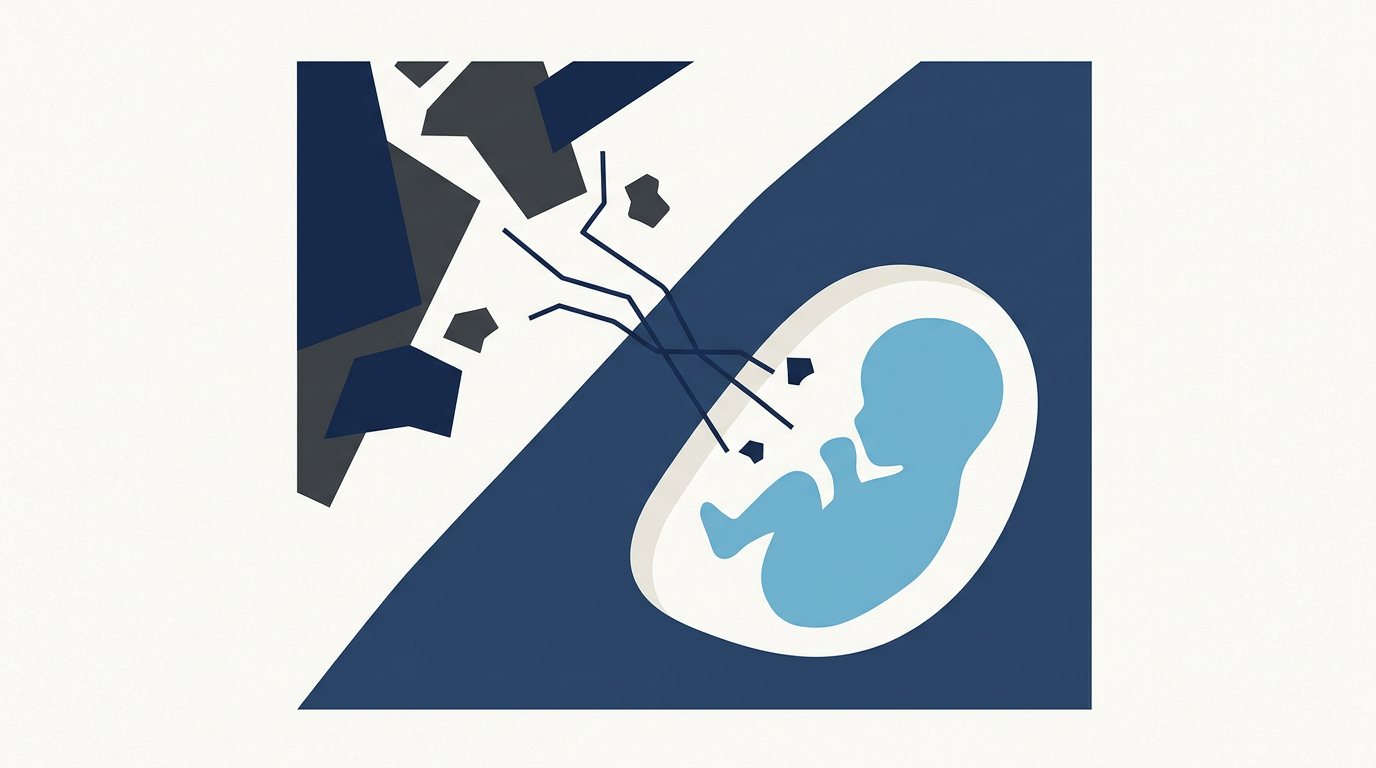
How Air Pollutants Cross the Placental Barrier
In 2001, researchers at Columbia University began recruiting pregnant women in northern Manhattan and the South Bronx — communities with some of the highest traffic density in the United States. They strapped small backpack monitors to the women during the third trimester, tracking their personal exposure to polycyclic aromatic hydrocarbons, the combustion byproducts that saturate urban air near heavy traffic.
Then they followed the children. For years.
By age three, the children born to mothers with the highest PAH exposure showed measurably delayed psychomotor development and higher rates of attention difficulties. By age seven, they had lower IQ scores. The differences weren't dramatic in any individual child — but they were consistent, statistically robust, and they showed up before those children had spent years in polluted air themselves. The exposure that shaped their development happened before they were born.
This is the uncomfortable truth about prenatal air pollution: the womb is not a sealed chamber. Particulate matter, gases, and combustion byproducts cross the placenta. They reach the fetal bloodstream, the developing brain, the lungs that haven't yet taken their first breath. The windows of vulnerability that matter most may open months before anyone knows to protect them.
Trimester-Specific Risks and Vulnerable Windows
Pregnancy is not a uniform period of risk. The biological processes underway shift dramatically from trimester to trimester — and the same pollutant can have different effects depending on which developmental process it disrupts.
First trimester: organogenesis This is when organs form from scratch. Cardiac tissue, neural tube, and major structural development all happen in the first 12 weeks. Exposure to air pollutants during this period — particularly ozone and PAHs — has been associated with cardiac defects and neural tube abnormalities in some studies, though the evidence is less consistent here than in later trimesters.
Second trimester: rapid growth Brain development accelerates. Neural connections are forming, the cortex is layering, and the lungs are beginning their long process of maturation. PM2.5 exposure in the second trimester has been linked to preterm birth risk, and some studies find the strongest associations between traffic pollution and cognitive outcomes for exposures concentrated in this window.
Third trimester: lung maturation and birth outcomes The lungs complete their key developmental stages in the third trimester — and this is when PM2.5 exposure most consistently predicts birth outcomes. Low birth weight, preterm birth, and reduced lung function at birth all show significant associations with third-trimester air pollution exposure across multiple large studies and countries.
The cumulative picture Across all three trimesters, the most consistent finding is a dose-response relationship: more exposure, worse outcomes. There is no trimester that is risk-free, and no level of exposure that has been identified as safe.
Birth Outcomes Linked to Prenatal Air Pollution
The birth outcomes literature on prenatal air pollution is now substantial — hundreds of studies, dozens of countries, millions of births. The consistent findings:
Preterm birth One of the strongest and most replicated associations in environmental perinatal research. A natural experiment studying E-ZPass toll booth implementation — which dramatically reduced traffic near toll plazas — found that communities with less traffic congestion had measurably lower rates of preterm birth. The reduction in air pollution caused the improvement.
Low birth weight Low birth weight (under 2,500g) is associated with prenatal PM2.5 exposure in cohort after cohort. The mechanism involves placental inflammation and reduced placental blood flow — the same systemic inflammatory pathway that affects adult cardiovascular risk.
Respiratory outcomes Children born to mothers with higher prenatal PM2.5 exposure have reduced lung function at birth and higher rates of respiratory wheeze and asthma in early childhood. This is the starting point from which the childhood air pollution literature picks up — and the two bodies of evidence tell a continuous story.
Neurodevelopmental outcomes The Columbia cohort findings have been replicated across multiple continents. Prenatal exposure to traffic pollution, PAHs, and PM2.5 is associated with cognitive and attention outcomes in early childhood — effects that appear to be independent of postnatal exposure, pointing to prenatal as a genuinely distinct and important window.
Steps Pregnant Women Can Take to Reduce Exposure
Pregnancy is not the time for paralysing anxiety about air quality — but it is a reasonable time for targeted, practical risk reduction.
Highest-impact changes: • Avoid prolonged outdoor exercise near heavy traffic, particularly in the first and third trimesters. Choose parks and routes away from major roads. • Run a HEPA air purifier in your bedroom throughout pregnancy. You spend roughly a third of your life there, and it's the easiest room to consistently clean. • Check air quality before outdoor time — PollutionProfile's Air Quality feature gives you a daily local reading so you're not guessing. On high-AQI days, keep outdoor time short. • Address indoor sources: switch to fragrance-free cleaning products, ensure your kitchen is well-ventilated when cooking, and avoid renovations that disturb materials that might contain lead paint or off-gas VOCs.
Conversations worth having: If you live near a highway, industrial facility, or in an area with consistently elevated PM2.5, it's worth raising air quality with your obstetrician. Not to create alarm — the absolute risk for any individual pregnancy remains relatively low — but because it's relevant clinical information and because some practical accommodations (indoor filtration, modified outdoor routines) are straightforward.
Log your pregnancy address history PollutionProfile's Historical Exposure Recorder lets you document where you lived during pregnancy, linking that address to historical air quality data. That record may be valuable for your child's medical history as they grow up.
References
- Trasande, L., Thurston, G. D. (2005). The role of air pollution in asthma and other pediatric morbidities. Journal of Allergy and Clinical Immunology, 115(4), 689–699.
- Currie, J., & Walker, R. (2011). Traffic congestion and infant health: Evidence from E-ZPass. American Economic Journal: Applied Economics, 3(1), 65–90.
- Perera, F. P., Rauh, V., Whyatt, R. M., Tsai, W. Y., Tang, D., Diaz, D., ... & Camann, D. E. (2006). Effect of prenatal exposure to airborne polycyclic aromatic hydrocarbons on neurodevelopment in the first 3 years of life among inner-city children. Environmental Health Perspectives, 114(8), 1287–1292.