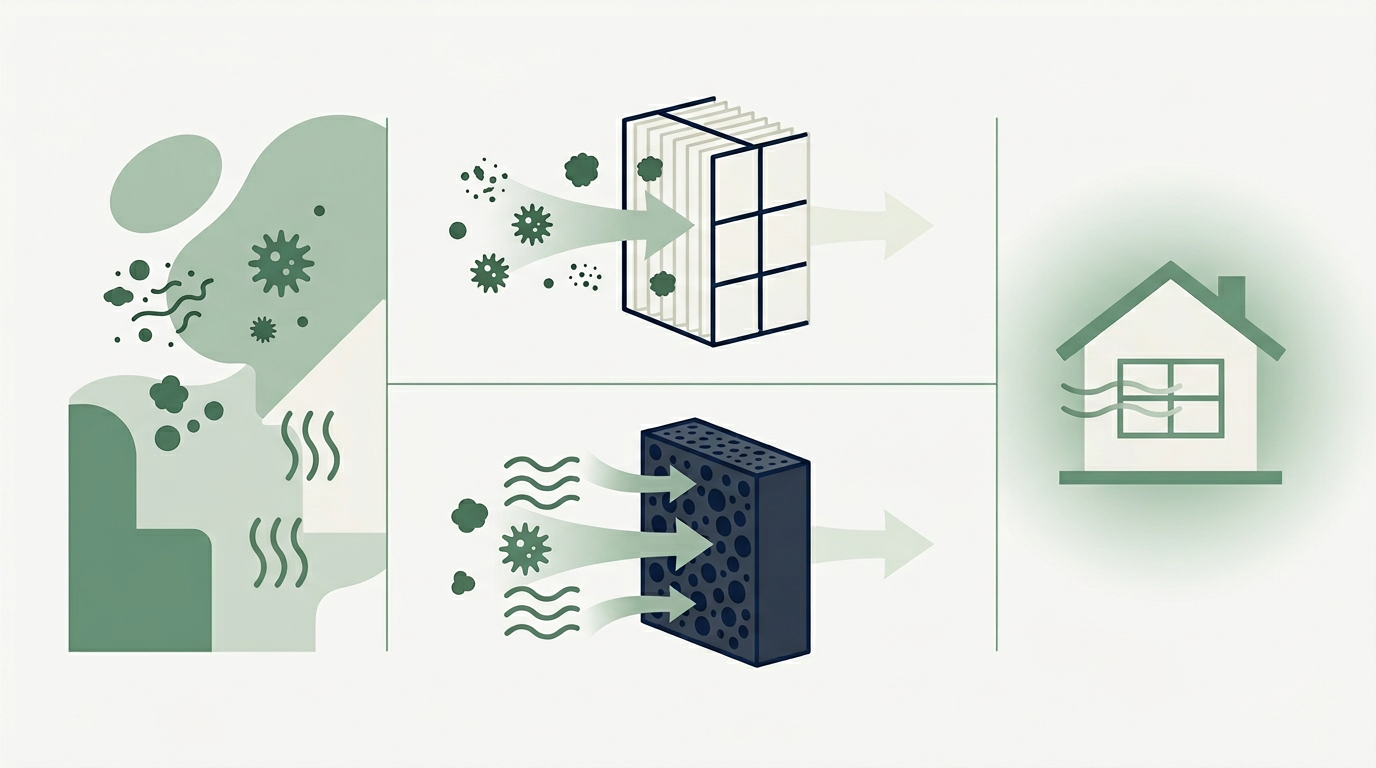
HEPA Filtration: Particle Size Efficiency and Real-World Performance
The HEPA filter — High-Efficiency Particulate Air — is the most evidence-supported indoor air quality intervention available to consumers. Its physics are simple and its performance is well-characterised: a HEPA filter physically captures particles by interception, impaction, and diffusion mechanisms, removing at least 99.97% of particles 0.3 micrometres in diameter — the most penetrating particle size — and higher efficiency for both larger and smaller particles.
The 0.3 micrometre MPPS (most penetrating particle size) standard is the relevant benchmark because it represents the particles hardest to capture. Below 0.3 µm (ultrafine particles) and above it (coarse particles), HEPA efficiency is actually higher than 99.97%. The standard is designed to guarantee performance at the point of worst-case performance.
Understanding HEPA's actual mechanism — physical filtration — helps distinguish it from technologies that make similar claims through very different mechanisms with very different evidence profiles. HEPA filtration removes particles from air by physically entrapping them. It doesn't generate ozone, doesn't produce ions, doesn't create reactive oxygen species, and doesn't require ongoing chemical inputs. It removes particles. That's all — and for PM2.5, which drives the most significant health consequences of indoor air pollution, that's enough.
Activated Carbon for VOCs and Gases: What It Removes
For gaseous pollutants — VOCs, formaldehyde, NO₂, ozone — HEPA filtration provides no benefit. These are molecular-scale species that pass through HEPA media as if it weren't there. Activated carbon is the technology for gas-phase indoor air pollutants.
How activated carbon works Activated carbon is a highly porous material — typically derived from coconut shells, coal, or wood char — with an enormous internal surface area (500–1,500 m² per gram). Gas-phase pollutants adsorb onto the carbon surface through van der Waals forces. The capacity is finite — once the adsorption sites are saturated, the carbon must be replaced.
What activated carbon removes: • VOCs: most organic solvents, toluene, xylene, benzene (at sufficient carbon bed depth) • Formaldehyde: some activated carbon removes it, but specific carbon formulations with impregnated potassium permanganate or amine groups are more effective • Ozone: activated carbon reduces ozone through both adsorption and catalytic decomposition • NO₂: limited removal by standard activated carbon; some specialised media performs better • Odours: highly effective for most odour-causing compounds
What activated carbon does not remove: • Particles (PM2.5, PM10) — no physical filtration mechanism • Radon — requires specific media (not typically available in consumer purifiers) • Carbon dioxide — not an adsorbable molecule at room temperature on standard carbon
Combined HEPA + activated carbon The most capable consumer air purifiers combine a HEPA stage with an activated carbon stage — addressing both particle and gaseous pollutants. The carbon bed weight matters: thin carbon pre-filters provide limited gas removal compared to thick (3+ kg) carbon beds in higher-quality units.
UV, Ionizers, and Ozone Generators: Evidence and Cautions
The alternative air cleaning technologies marketed alongside and instead of HEPA+carbon systems require careful evaluation, because several generate pollutants themselves.
Ionizers and electrostatic precipitators Ionizers charge particles, causing them to deposit on surfaces. They do reduce airborne particle concentrations, but deposited particles aren't eliminated — they remain on surfaces and can be re-suspended. More significantly, many ionizers generate ozone as a byproduct. The EPA and California Air Resources Board have documented that ozone levels in rooms with ionizers can exceed health standards. Not recommended as primary air purifiers.
Ozone generators Sometimes marketed as "air purifiers" or "air sanitisers," ozone generators deliberately produce ozone to oxidise chemical contaminants. Ozone does react with and degrade some VOCs — but often produces more harmful secondary pollutants (formaldehyde, acrolein, fine particles) from these reactions than were present before treatment. The EPA explicitly warns against using ozone generators as indoor air purifiers in occupied spaces. They have a legitimate use in unoccupied space remediation (post-flood, post-fire) when properly applied by professionals.
Photocatalytic oxidation (PCO) Used in some air purifiers, PCO uses UV light and a titanium dioxide catalyst to oxidise pollutants. Some PCO systems have been found to produce formaldehyde and other aldehydes as incomplete oxidation byproducts. The technology has promise but current consumer implementations have mixed evidence for net benefit.
UV-C germicidal irradiation UV-C light inactivates airborne pathogens — viruses and bacteria — and has genuine evidence for this specific application (healthcare infection control). For chemical pollutants (PM2.5, VOCs), UV-C provides no benefit.
Sizing, Placing, and Maintaining Your Air Filtration System
The practical questions for air filtration are: which room, what CADR, where in the room, and what maintenance schedule.
Room prioritisation The bedroom is the highest-priority room for air purification because it is where most people spend the most continuous time (7–9 hours) and because pollutant exposure during sleep is particularly consequential — the body's overnight repair and glymphatic clearance processes operate against a background of whatever air quality is in the room.
The primary living area is second priority; kitchen (particularly with gas cooking) is third.
CADR and room sizing Clean Air Delivery Rate (CADR) measures the volume of clean air an air purifier produces per minute — standardised by AHAM testing. Match CADR to room size: a room of 400 sq ft requires approximately CADR 250–300 cfm (cubic feet per minute) for meaningful particle reduction at standard ceiling heights. Oversizing is generally better than undersizing.
Placement Place the purifier where it can circulate room air freely — not in corners or behind furniture. For bedrooms, a location near the bed but not directly blowing on the sleeping person is optimal. Running on low speed continuously provides more total air cleaning than running on high speed intermittently.
Maintenance True HEPA filters should be replaced every 6–12 months depending on use and local pollution levels — more frequently in high-pollution areas. Activated carbon needs replacement every 3–6 months as adsorption capacity saturates. Indicator lights on modern purifiers are useful but should be supplemented by noting filter replacement dates, as sensors aren't always accurate.
References
- Allen, J. G., MacNaughton, P., Satish, U., Santanam, S., Vallarino, J., & Spengler, J. D. (2016). Associations of cognitive function scores with carbon dioxide, ventilation, and volatile organic compound exposures in office workers. Environmental Health Perspectives, 124(6), 805–812.
- U.S. Environmental Protection Agency. (2018). Guide to air cleaners in the home. EPA Indoor Air Division.
- Fisk, W. J. (2013). Health benefits of particle filtration. Indoor Air, 23(5), 357–368.